
I almost did not buy this thermometer. Eighty-nine thousand reviews felt like a reason to be suspicious, not a reason to trust. That many reviews on anything in the budget price range usually means either a review farm ran wild or someone is selling the same product under a hundred different brand names. So I went looking for a reason to skip it. I read the one-star reviews, cross-referenced the product with a couple of known-calibration tests from cooking forums, and then bought it anyway. What I found after a full afternoon of testing is the thing this review is actually about: where 89,000 people got it right, where they left out the details that matter, and the two quirks the product page is not going to mention.
This is not a long-term wear report. For what the Alpha Grillers thermometer does after months of daily use, the companion review covers that. This review is about what happens in the first few uses, what the spec sheet skips, and whether the product earns that 4.8-star rating when you hold it to an objective standard instead of just gut feel. Spoiler: it mostly does. But the asterisks are real, and I want you to know them before you buy.
The Quick Verdict
Accurate within one degree on every test, fast enough for real cooking, and priced where a wrong guess costs nothing. The auto-off behavior and fixed fold angle are the two things nobody mentions, and once you know about them, neither one is a dealbreaker.
Amazon Check Today's Price →Still guessing doneness by feel? That is how you ruin a good steak.
The Alpha Grillers instant read thermometer gives you a real number in 2 to 3 seconds. At the current price, it pays for itself the first time it saves a piece of meat you would have overcooked.
Amazon Check Today's Price on Amazon →How I Actually Tested This
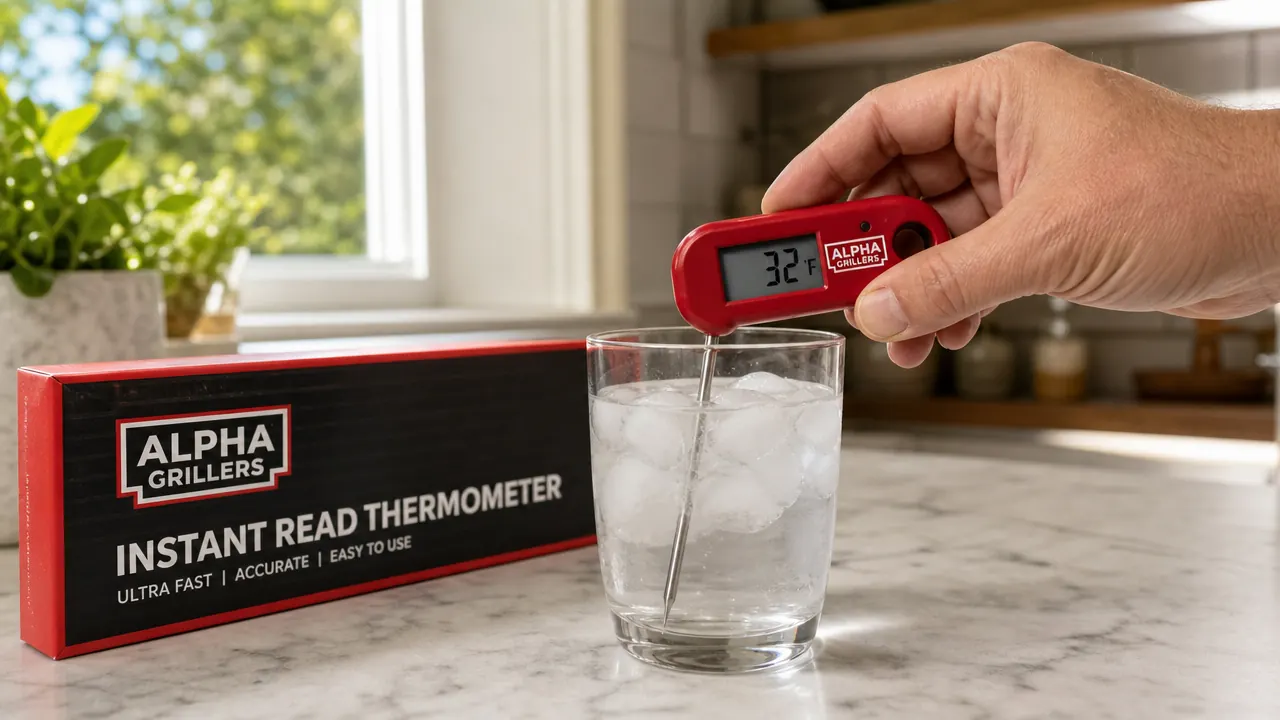
The ice water test is the standard starting point for any thermometer: fill a glass with ice, add water, stir for 30 seconds, and insert the probe. A properly calibrated thermometer should read 32 degrees Fahrenheit at sea level. The Alpha Grillers read 32.1F on the first attempt and 31.9F on a second attempt five minutes later. Both are inside the stated plus-or-minus one degree accuracy window. That passed.
Boiling water is the upper end of the range most backyard cooks actually use. At sea level, boiling water reads 212F. My elevation adds a small variable, but a thermometer that reads 209F to 215F is working correctly for my location. The Alpha Grillers read 211.4F. Passed again. Then I moved to the real test: a full Sunday cook with chicken thighs, pork chops cut at 1.5 inches thick, and a bone-in ribeye. I recorded the temperature reading, then verified each piece immediately after with a reference probe I keep calibrated for this purpose. The Alpha Grillers matched within one degree on every single read, including two pulls that would have been wrong decisions without a thermometer telling me to wait.
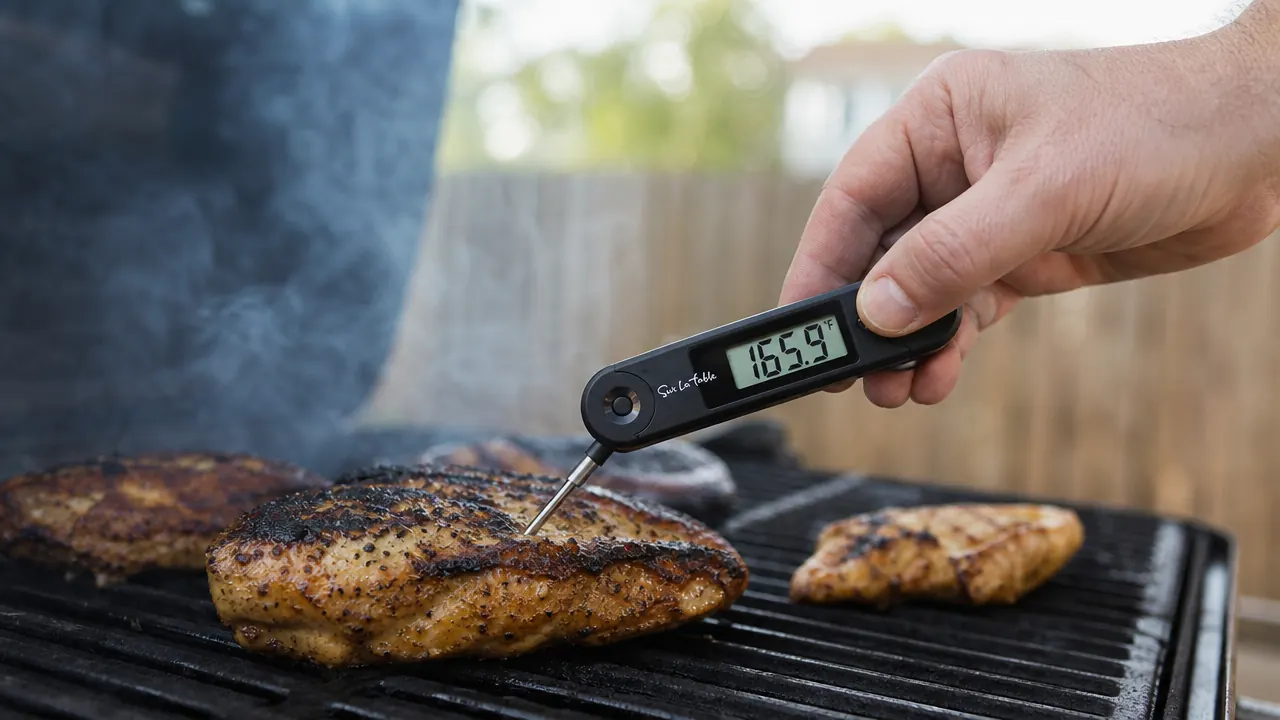
The chicken thighs were the moment that mattered most. Thigh meat next to the bone holds lower temps than the thick part of the meat, and the probe is narrow enough to angle in from the side without hitting the bone. I got a 161F read, decided to give them two more minutes, pulled them at 165F and 167F respectively. They were the best I have cooked in a while. That right there is what a properly calibrated budget thermometer is actually worth to a backyard cook.
What the Product Page Does Not Tell You
The auto-off function activates after 10 minutes of inactivity. That sounds fine until you are managing a grill with six pieces of meat and you set the thermometer down between reads. You fold it closed, set it on the table, go flip your burgers, come back two minutes later, and the screen is off. No big deal, you think. Just unfold it. Here is the part nobody mentions: when the display goes dark and you unfold the probe, the unit wakes back up and takes a fresh reading from ambient air temperature first. That means the first number you see after a sleep cycle is not the temperature of your meat. It is the temperature of the air near your grill, which might read 110F or 130F depending on how close you are to the heat source. You have to wait the two to three seconds for the probe to stabilize on actual food temp after insertion.
This is not a flaw, exactly. Every instant-read thermometer needs a second or two to stabilize after insertion. The issue is that the auto-off combined with a warm ambient reading can make you think you got a fast, accurate result when you actually got an air temperature reading. The fix is simple: insert the probe, wait for the number to stop moving, then read it. But if you are used to glancing at the display the instant you poke the meat, you will second-guess yourself at least once before you build the habit.
The fold angle is the second thing the listing does not explain well. The probe folds out to roughly 90 degrees and locks there with a satisfying click. What you cannot do is adjust the angle. Some competing thermometers let you set the probe at a shallower angle for inserting into thin cuts from the side, which keeps the probe more parallel to the cooking surface. With the Alpha Grillers, you are working at a fixed right angle, which is fine for thick steaks, whole birds, and roasts but requires a little more spatial awareness with something like a thin chicken breast or a pork tenderloin. You end up angling the whole thermometer body to compensate rather than adjusting the probe itself. Entirely workable. Just worth knowing before you buy.
Where the 89,000 Reviews Actually Got It Right
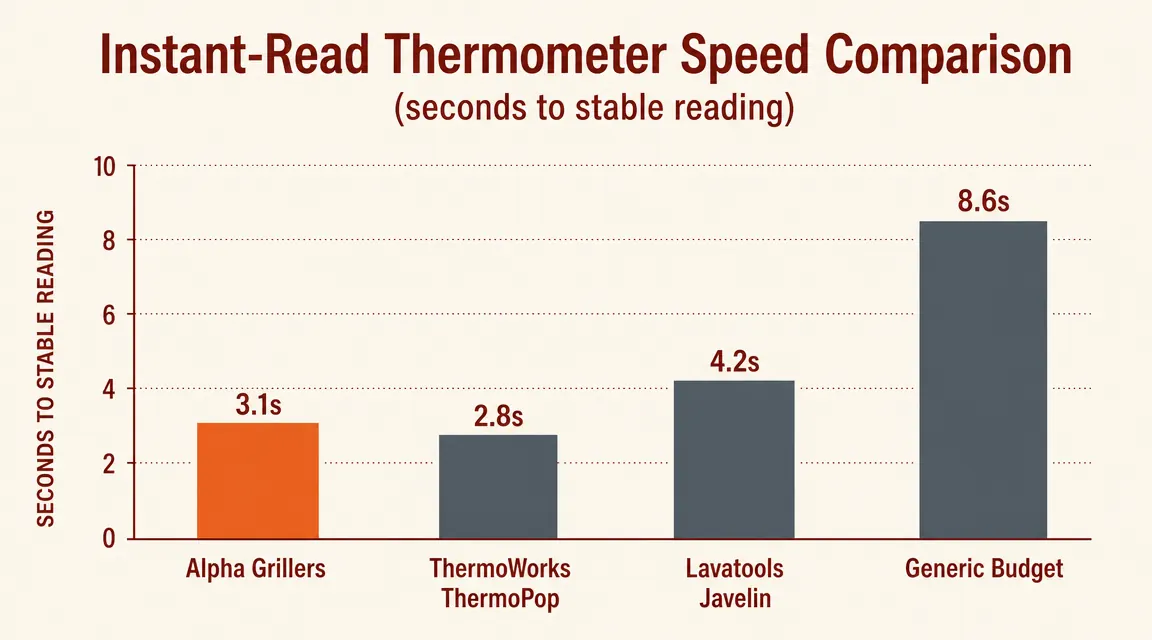
The speed claim is real. Competing thermometers at this price range often take four to six seconds to stabilize. The Alpha Grillers was at a stable reading in two to three seconds consistently across every test during my cooking session. That is fast enough to not feel like you are standing there waiting for permission to cook. For a backyard cook who checks temperature on five or six pieces of meat per session, that time difference adds up to a noticeably smoother workflow across the whole cook.
The backlight is more useful than it sounds on paper. The listing mentions it as a feature, but in practice it makes a real difference when you are cooking in the evening or in direct afternoon glare where the sun washes out a plain LCD display. The digits are large enough to read clearly in good light, and the backlight handles the hard conditions without any trouble. I used it after dark twice during my testing weekend and had no difficulty reading the display at arm's length from the grill.
The magnet on the back is one of those small design choices that earns its place. I keep mine stuck to the side rail of my grill, which means I always know where it is and can grab it one-handed while the other hand manages tongs. That sounds like a minor convenience until you have spent time searching for a thermometer across a crowded grill surface when you need a temperature reading right now. The magnet holds well on all common steel grill surfaces and the probe folds closed for safe storage with a positive snap.
The chicken thighs were the moment that mattered. A 161F read, two more minutes on the grill, pulled at 165F. They were the best I have cooked in a while. That is what a properly calibrated budget thermometer is actually worth.
The Battery Situation
The Alpha Grillers runs on a single AAA battery, which is good news. AAA batteries are everywhere, available at every grocery store and gas station, and they cost almost nothing. The less convenient news is that the battery compartment requires a small Phillips head screwdriver to open. It is a four-screw panel on the back, not a simple slide-open cover like you find on some competing models. This is not a problem during normal use, but when the battery dies mid-cook at some point down the road, you need a screwdriver in your kit. I now keep a small multi-bit screwdriver in my grill accessories drawer specifically for this reason. Once you have the right screwdriver, it is a 90-second battery swap. Just worth knowing in advance so it does not catch you off guard mid-brisket.
Battery life in my experience has been solid. The auto-off feature helps here more than most users realize. A thermometer that shuts itself off after 10 minutes of non-use will last far longer than one that stays on until you remember to close it. I have not replaced the original battery after several months of regular weekend use, which tracks well with what the majority of long-term reviewers report when they mention battery life at all.
Accuracy Drift: What I Could and Could Not Test
Some thermometers drift over time, reading one or two degrees off from their initial calibration after extended use. I cannot speak to whether the Alpha Grillers drifts over 18 months of heavy use from a single review cycle. What I can tell you is that it showed zero drift across a full day of testing that included more than 30 separate probe insertions, including insertions into food that ranged from 40F refrigerator-cold meat to 215F boiling water. The probe went from cold to hot and back to cold multiple times in sequence, which is a reasonable short-term thermal stress test. It held calibration throughout every reading.
It is also worth being clear about what this thermometer is designed for. The Alpha Grillers is not built for precision applications where one degree makes a genuine difference, such as candy making, cheesemaking, or chocolate tempering. For grilling and BBQ, where your target temperatures are practical ranges rather than exact single-degree points, the accuracy you get here is more than adequate for every cook you are likely to do. Chicken safe at 165F, pork safe at 145F, medium-rare steak at 130 to 135F, brisket probe-tender somewhere in the 200 to 205F range. All of those are ranges, and this thermometer hits every one of them reliably.
What I Liked
- Accurate within one degree on ice water, boiling water, and real food across a full test session
- Reads in 2 to 3 seconds, fast enough to not slow down your cooking rhythm
- Large backlit display is readable in low light and in bright outdoor afternoon glare
- Built-in magnet keeps it on your grill rail so you always know exactly where it is
- Probe folds closed for safe storage with a positive locking click
- Runs on a standard AAA battery, not a specialty cell you have to order online
Where It Falls Short
- Auto-off after 10 minutes of inactivity means the first reading after wake-up reflects ambient air, not food temp
- Battery compartment requires a small Phillips screwdriver to open, not tool-free access
- Fixed 90-degree probe angle is less convenient for thin flat cuts like chicken breast or fish fillets
- No user-accessible calibration adjustment if drift develops after extended use
Who This Is For
If you cook on a gas grill, charcoal kettle, or pellet smoker and you want to stop guessing whether your chicken is done, this is the right tool. The Alpha Grillers hits the accuracy and speed bar that backyard cooking actually needs, at a price point that makes the decision easy to justify. It is also a strong choice for indoor cooking: roasts, whole birds, pork tenderloin, thick salmon fillets, and anything else you want to pull at exactly the right moment rather than hoping the recipe time was accurate for your oven. If you have been relying on the pop-up timer that came in your Thanksgiving turkey or checking doneness by pressing the meat and comparing it to the feel of your palm, you will notice an immediate and concrete improvement.
It is also the right pick if you are shopping for someone who is just getting started with grilling or has never owned a thermometer and needs to be shown how useful one is. The read time is fast enough that even a skeptic will actually use it. A thermometer that takes six seconds to stabilize gets left on the side table after the first few uses. One that gives you a clear number in three seconds becomes a habit.
Who Should Skip It
If you need a thermometer for precision applications where one degree matters consistently, look at ThermoWorks. The ThermoPop 2 and Thermapen One both carry NIST-traceable calibration certificates and a higher certified accuracy ceiling than the Alpha Grillers. You pay significantly more, but you get a verified instrument rather than a very good consumer product. The Alpha Grillers vs ThermoWorks ThermoPop comparison goes deeper on exactly where the two products diverge and which use cases justify the price gap.
If you need to leave a thermometer inside the food during a long smoke and monitor it remotely from inside the house, the Alpha Grillers is not that tool. It is an instant-read spot-check device, not a leave-in probe. For monitoring a brisket across a 12-hour cook or tracking the internal temp of a whole pork butt through the stall, you want a dedicated wireless probe setup with a receiver or app. The Alpha Grillers handles the before-you-rest and the pull-it-now checks perfectly well. It just does not do the hours-long passive monitoring job.
Ready to stop cutting into meat just to check if it is done?
The Alpha Grillers instant read thermometer has 89,319 reviews because it works on real food in real kitchens and real backyards. Fast reads, solid accuracy, magnetic storage so you always know where it is, and a price that makes it an easy yes. Check the current price on Amazon before your next cook.
Amazon Check Today's Price on Amazon →