
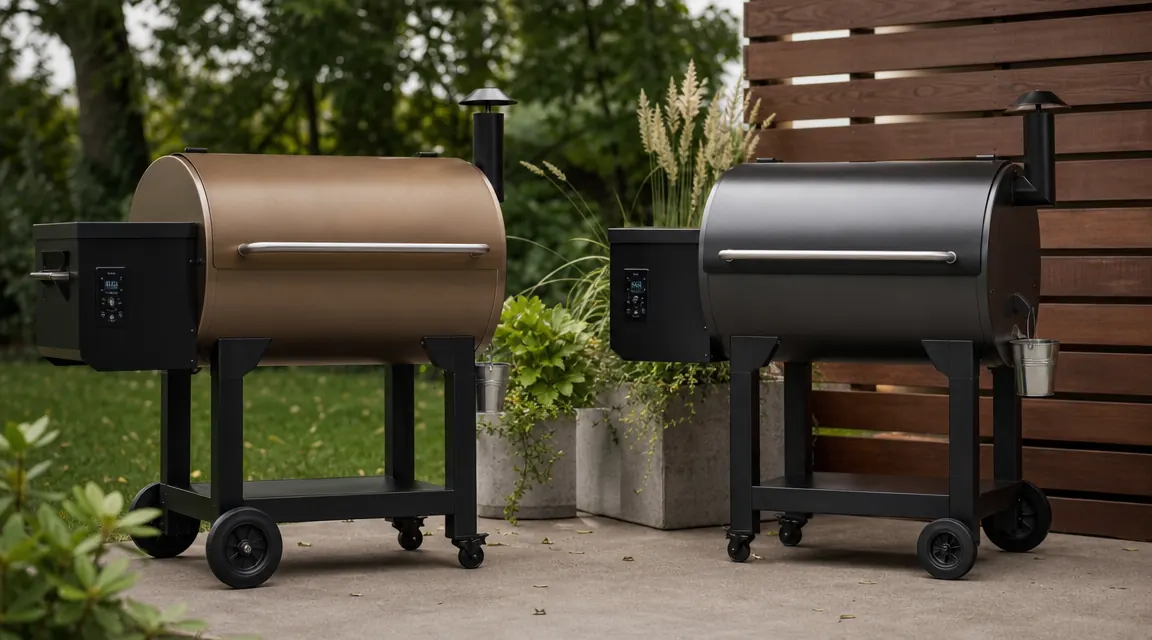
If you have ever tried to research which pellet grill to buy, you know exactly how this goes. You start with a simple question, and two hours later you are buried in Reddit threads where one commenter swears by the Traeger Pro 34 and another calls it overpriced junk, while a third says Pit Boss is just as good for half the money. None of them agree. None of them explain the trade-offs in plain English. I spent a long time in that same hole before I actually cooked on both. Here is what I found: this is not a "just buy the cheap one" versus "just buy the name brand" decision. It is a question of what you plan to cook, how often you cook it, and whether the spec differences between these two grills actually show up on the plate. For most backyard cooks doing real low-and-slow work, the Traeger Pro 34 is the clearer choice. But let me show you exactly why, so you can decide for yourself.
The short answer is this: both grills produce real wood-fired flavor, both will cook a decent rack of ribs, and both are a genuine upgrade over a cheap big-box grill. The difference shows up in the details, and the details matter most when you are cooking something that takes eight, ten, or twelve hours. Temperature consistency, grease management, app connectivity, and the feel of the hardware after two or three seasons of use, those are the places where these grills separate. I will walk through each one.
| Traeger Pro 34 | Pit Boss | |
|---|---|---|
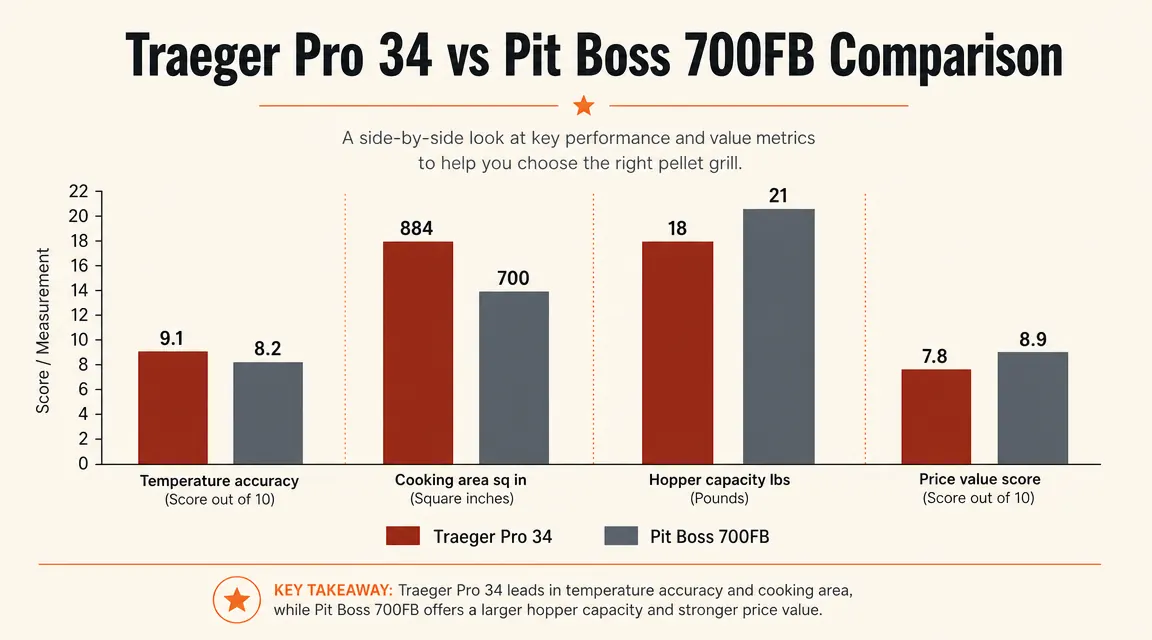
| Cooking Area | 884 sq in (main + upper rack) | 700 sq in |
| Temperature Range | 165°F to 450°F | 180°F to 500°F |
| Temperature Accuracy | +/- 15°F variance typical | +/- 25°F variance typical |
| Hopper Capacity | 18 lbs | 21 lbs |
| Build Material | Powder-coated steel, bronze lid | Powder-coated steel, black lid |
| WiFi / App Control | WiFIRE app included | None on base model |
| Grease Management | Front-mounted bucket, easy access | Bottom drain, bucket underneath |
| Warranty | 3 years | 5 years |
| Price | Higher (current price on Amazon) | Lower |
If temperature swings are ruining your long cooks, the Traeger Pro 34 holds the line where Pit Boss lets go.
884 square inches of cooking space, WiFIRE app monitoring, and a Digital Arc controller that holds your set point within 15 degrees. Check the current price on Amazon and see if it fits your budget before deciding.
Amazon Check Today's Price on Amazon →Where the Traeger Pro 34 Wins
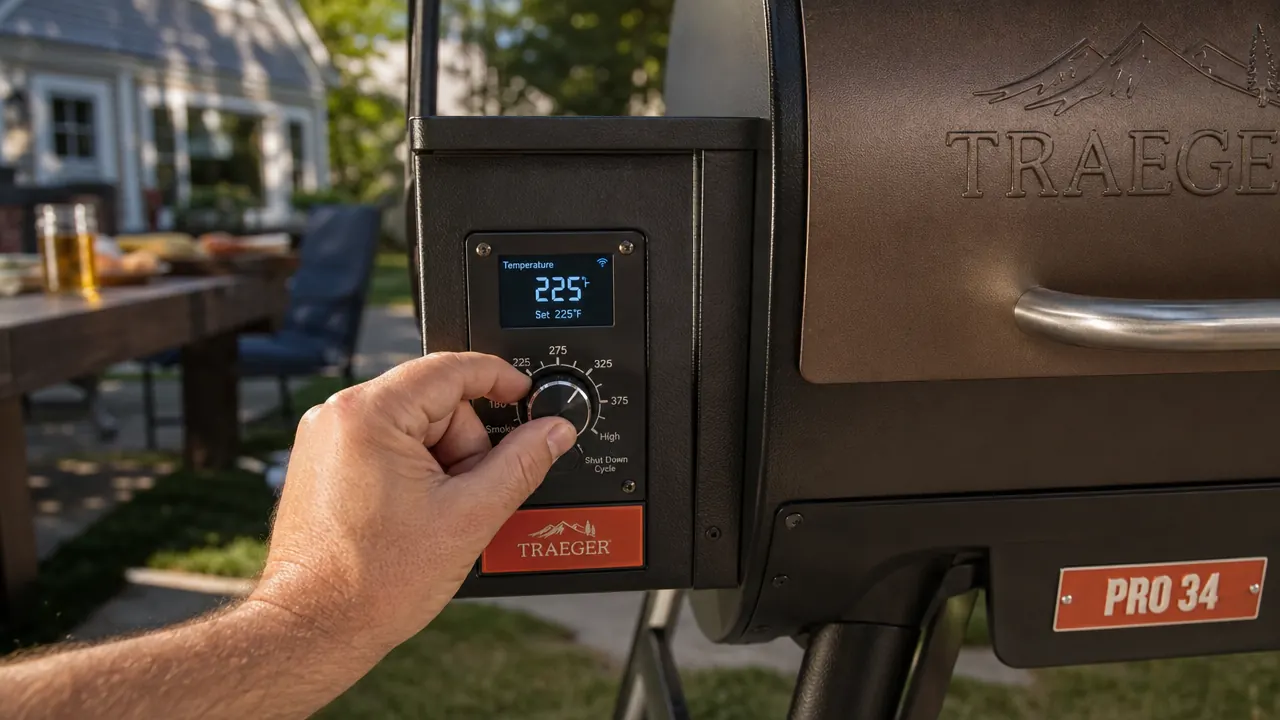
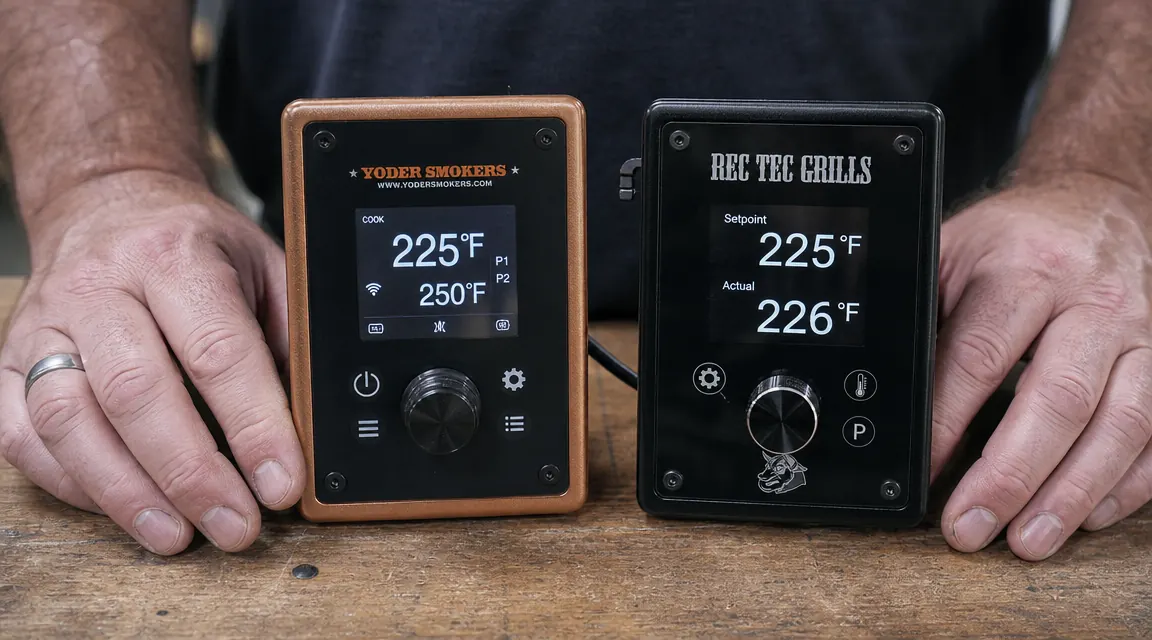
Temperature accuracy is where Traeger has put its engineering investment, and you feel it the moment you start a serious cook. The Pro 34 uses a Digital Arc controller that holds your set point to within about 15 degrees Fahrenheit under normal conditions. That sounds like a footnote in a spec sheet, but on a brisket cook it is the whole ballgame. Here is what happens in practice: you set the grill at 225 degrees, load a 12-pound brisket, and walk away. On the Traeger, that brisket is going to sit in a consistent smoke environment for the next ten to twelve hours. The bark develops evenly. The connective tissue breaks down at the rate you want. You are not fighting the grill. On a grill with a 25-degree swing, you are spending part of your cook at 200 and part at 250, and the meat does not care that you set the dial at 225. It responds to what it actually got, and the difference shows in an uneven bark and a texture that is harder to predict.
Think about what you are actually trying to do when you smoke ribs low and slow. You want the collagen in the meat to convert to gelatin without the exterior drying out before the inside is done. That process happens in a fairly narrow band of temperature. When a grill swings 25 to 30 degrees, it is pushing you in and out of that band repeatedly. The Traeger's tighter hold means the meat gets a more consistent cooking environment from the first hour to the last. For a beginner who is still learning to read their food, that consistency removes one of the biggest variables from an already complex process.
The WiFIRE app integration is one of those features that sounds like a gimmick until you actually use it. The first time you sit on your back porch with your kids, glance at your phone, and see that the grill has held 225 degrees for four hours without you touching it, you understand what the whole pellet grill value proposition is supposed to feel like. You are not babysitting a fire. You are having a Saturday. Pit Boss does not offer WiFi on the base 700FB model, so that monitoring capability simply is not there. If you want to run a long cook and actually be present for your family instead of walking out to check the grill every 45 minutes, that is a meaningful gap between these two options.
The grease management on the Traeger is also noticeably better in day-to-day use. The front-mounted drip bucket is right there when you open the lid, easy to pull out and empty. After a pork shoulder or a brisket cook, there is going to be a significant amount of rendered fat to deal with. The Pit Boss bottom-drain system works, but it requires getting down low to access the bucket underneath the grill, which is annoying after a long cook when you are tired and the bucket is full of hot grease. Small thing. Adds up every single cook.
Where Pit Boss Wins
Pit Boss earns genuine points in two areas, and you should take them seriously. The first is price. The 700FB typically comes in meaningfully lower than the Traeger Pro 34, and that gap is real money. If your budget has a firm ceiling and a Traeger simply does not fit, Pit Boss is not a consolation prize. It is a legitimate pellet grill that will produce wood-fired flavor and handle a weekend cook. For someone who is mostly grilling chicken thighs, burgers, and the occasional rack of ribs at higher heat, the precision advantage of the Traeger controller matters less, and the price difference starts to look like an easy call.
The second area where Pit Boss has a real edge is high-heat cooking. The 700FB reaches 500 degrees versus the Traeger's 450-degree ceiling. If you want to do hard sears on steaks or cook burgers at full blast, that extra 50 degrees is a genuine capability gap. Some people buy a pellet grill specifically to replace their gas grill entirely, and for those cooks, the higher max temperature on the Pit Boss is an actual advantage. The Traeger's 450-degree max is enough for most purposes, but if you are a high-heat cook as often as a low-and-slow cook, Pit Boss's ceiling matters.
Pit Boss also runs a larger hopper at 21 pounds versus the Traeger's 18 pounds, and backs their grills with a 5-year warranty compared to Traeger's 3 years. The hopper difference is minor in practice, since most serious cooks top off before a long session anyway, but the warranty gap is worth noting. That said, Traeger's parts network and customer service infrastructure are considerably larger and more established, so warranty service in practice often goes more smoothly on the Traeger side even with the shorter coverage period.
On a long smoke, a 15-degree temperature swing is the difference between a brisket you are proud of and one you are explaining away to your guests.
The Temperature Control Gap in Real Cook Scenarios
Let me be specific about what temperature variance actually means across three different cooks, because this is the heart of the decision and most comparison articles gloss over it.
On a brisket, you are looking at a 10 to 14 hour cook at 225 degrees. The difference between a plus-or-minus 15-degree controller and a plus-or-minus 25-degree controller is compounded across every hour of that cook. With the tighter controller, the flat and point of the brisket cook more evenly, the bark develops at a predictable rate, and your window to pull the brisket at the right internal temperature is cleaner. With the wider swing, you get more inconsistency in how the bark forms, and it becomes harder to time the stall. Experienced pitmasters can work around a less precise controller because they have developed feel for their specific grill. Beginners do not have that yet, and a forgiving controller is a meaningful advantage.
On ribs, a three-to-two-one cook runs at 225, then 250, then 225 again with varying humidity. The Traeger's consistency means each phase hits close to what you set. The Pit Boss's wider swing means the 225-degree phase might average out correctly but has more variance within it. For baby back ribs, this often shows up as slightly uneven tenderness across the rack, where one end is perfect and the other is either a touch dry or a touch underdone. Again, not a disaster. Just harder to control.
On weeknight chicken thighs at 375 degrees, the temperature gap between these two grills is largely irrelevant. Chicken thighs are forgiving, the cook is short, and the margin for error is wide. If your primary use is weeknight proteins at moderate heat, both grills perform similarly and the Pit Boss price advantage becomes easier to justify. The Traeger's controller advantage is most pronounced on the long, low-heat cooks where small variances accumulate into real differences.
Pellet Consumption and Running Costs
Both grills burn through wood pellets at roughly comparable rates: somewhere between one and three pounds per hour depending on temperature and weather conditions. Wind and cold push consumption up on both. The Traeger's slightly smaller hopper means you may need to top it off once during a very long cook where the Pit Boss gives you a bit more runway, but in practice most backyard cooks check and top off their hoppers before any serious session anyway. The three-pound hopper difference is not a practical issue for most people.
Where running costs do differ slightly is in the auger behavior. The Traeger's tighter temperature management means the auger feed is more consistent because the controller is not over-correcting as often. On a grill with a wider temperature swing, the controller sometimes dumps pellets in bursts to chase the set point back up, which can cause uneven burn cycles in the fire pot. Over time, consistent auger feeding means fewer fire pot issues and a more predictable smoke output. This is not a dramatic difference in monthly pellet costs, but it does affect how reliably the grill performs across seasons of use.
Build Quality: Both Are Solid, One Is More Finished
Both grills use powder-coated steel construction, and both will show wear over time if you leave them uncovered through rain and season changes. Invest in a grill cover for either one. That said, when you stand next to both grills and handle them, the Traeger Pro 34 feels more substantial. The lid is thicker, the hinges are tighter, and the overall hardware, including the grease channel, the fire pot access panel, and the handle, has less flex and slop to it. The Pit Boss is built to a price point, and it shows in the small details without being a deal-breaker.
The more practical build quality difference shows up in year three or four of ownership. The Traeger's replacement parts ecosystem is significantly larger. If your igniter rod fails, your RTD temperature probe reads off, or your auger motor starts to drag, finding a compatible part for the Traeger is fast and relatively inexpensive. The same parts exist for Pit Boss, but the aftermarket is thinner and lead times can be longer. If you plan to own this grill for five or ten years, that replacement parts availability matters more than the initial build quality difference.
Who Should Buy the Traeger Pro 34
The Traeger Pro 34 is the right call if you plan to do any serious low-and-slow cooking: briskets, pork shoulders, long rib cooks, or whole chickens and turkeys. It is the right call if you want to actually walk away from the grill and trust that it is holding temperature without you hovering over it. The WiFIRE app means you can monitor from your phone while you are doing something else, and for a family that uses the grill regularly, that convenience pays off quickly.
It is also the right choice if you have been frustrated by a cheaper pellet grill before. If you have had a grill that ran hot, ran cold, produced inconsistent results despite doing everything right, or developed problems in year two that were expensive to fix, the Traeger Pro 34 is the version of this category that addresses those frustrations. The investment is higher, but if you are cooking for your family every weekend through spring, summer, and fall, the per-cook cost difference between these two grills is minimal over a three-year horizon. You are spreading that price gap across a lot of meals.
The Traeger is also a smart choice if you are new to pellet grilling and want a grill that rewards you with good results while you are still learning. The consistent temperature control means fewer cooks that go sideways due to equipment, which means you can actually learn from the food rather than from chasing a grill that will not hold steady. That learning curve is hard enough without a grill that adds unpredictability to the process.
Who Should Consider Pit Boss Instead
Pit Boss makes sense if your grilling is mostly weeknight dinners and weekend grilling at moderate to high heat rather than long low-and-slow smokes. If your typical cook is chicken thighs at 375, pork chops at 400, burgers and brats at higher heat, the temperature precision difference between these two grills will barely register in your results. You will eat well. You will enjoy the wood-fired flavor. And you will have kept a meaningful amount of money in your pocket.
Pit Boss also makes sense if you specifically want to sear at higher temperatures on the same grill. The 500-degree ceiling is a real capability that the Traeger cannot match, and if you are replacing a gas grill entirely and plan to cook steaks and burgers frequently alongside occasional smokes, that high-heat range is useful. Some Pit Boss models include a flame broiler, which gives you direct-flame access for searing, which the Traeger Pro 34 does not offer.
If you find a sale on a Pit Boss that puts it significantly below current Traeger pricing, and your cooking style is more varied than it is committed to long low-and-slow cooks, Pit Boss is a reasonable and defensible choice. It is just not the choice I would make for someone who wants the grill that works the same way every time, requires the least amount of hands-on management, and lasts a decade with minimal drama. For that cook, the Traeger Pro 34 is the one I recommend.
Two summers from now, you will either be glad you bought the grill that works the same way every single time, or you will be thinking about upgrading.
The Traeger Pro 34 is the one you will not want to replace. 884 square inches, WiFIRE app control, and a temperature controller that actually holds its set point. Check the current price on Amazon and see what other backyard cooks are saying.
Amazon Check Today's Price on Amazon →