
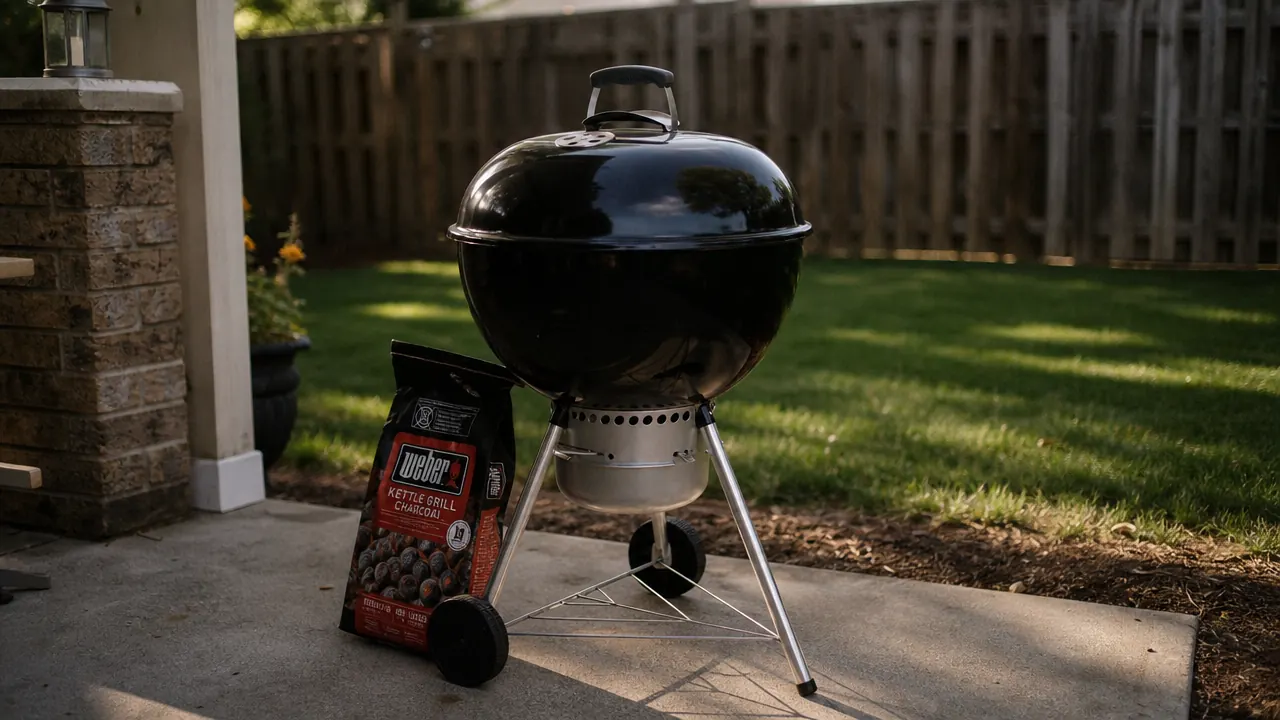
Here is what the 10,119 Amazon reviews will not tell you: the Weber Original Kettle 22-inch is a great grill that will frustrate you for the first three or four cooks. Not because it is poorly made. Not because it is the wrong tool. But because charcoal grilling has a real learning curve, and nobody who is trying to sell you a grill is going to lead with that. I am not trying to talk you out of this grill. I think it is the right choice for most backyard cooks at this price point. But if you buy it expecting the same experience you get with a gas grill -- turn a knob, set a temperature, walk away -- you are going to be annoyed before you find your footing. What I am going to do here is walk you through the things that surprised me, the things I wish someone had said plainly before I bought, and the honest picture of who this grill genuinely serves well and who should look elsewhere.
The Quick Verdict
The Weber Original Kettle earns its reputation -- but only after you accept that the first few cooks are a paid education, not a smooth onboarding.
Amazon Check Today's Price →If you've been burned by misleading grill reviews, here's the real picture before you buy.
The Weber Original Kettle 22-inch is the benchmark charcoal grill for a reason. The build is excellent, the vent system is precise, and with a little practice it will produce results that a gas grill simply cannot match. Go in knowing what to expect and you will love this grill. Current price and availability are linked below.
Amazon Check Today's Price on Amazon →How I Have Used It (The Honest Version)
I want to be upfront about my cooking setup before I tell you what I found. I am not a competition pitmaster. I do not have a dedicated outdoor kitchen or a fancy grilling station. I have a covered concrete patio in central Virginia, a folding table I grabbed from a garage sale, and a Weber Original Kettle that has been my main weekend grill for going on two years. My cooks range from fast weeknight chicken thighs to occasional long indirect cooks on ribs and whole chickens. I am a home cook who grills most weekends and figured out charcoal management by making mistakes, not by reading manuals.
I am also going to tell you things that I do not see covered honestly in most Weber reviews because most Weber reviews are written by people who already love charcoal grilling and want to convince you to join the club. That is a different exercise than helping a first-time buyer understand what they are getting into. So here is the real version.
Thing One: You Need a Chimney Starter and That Is Not Optional
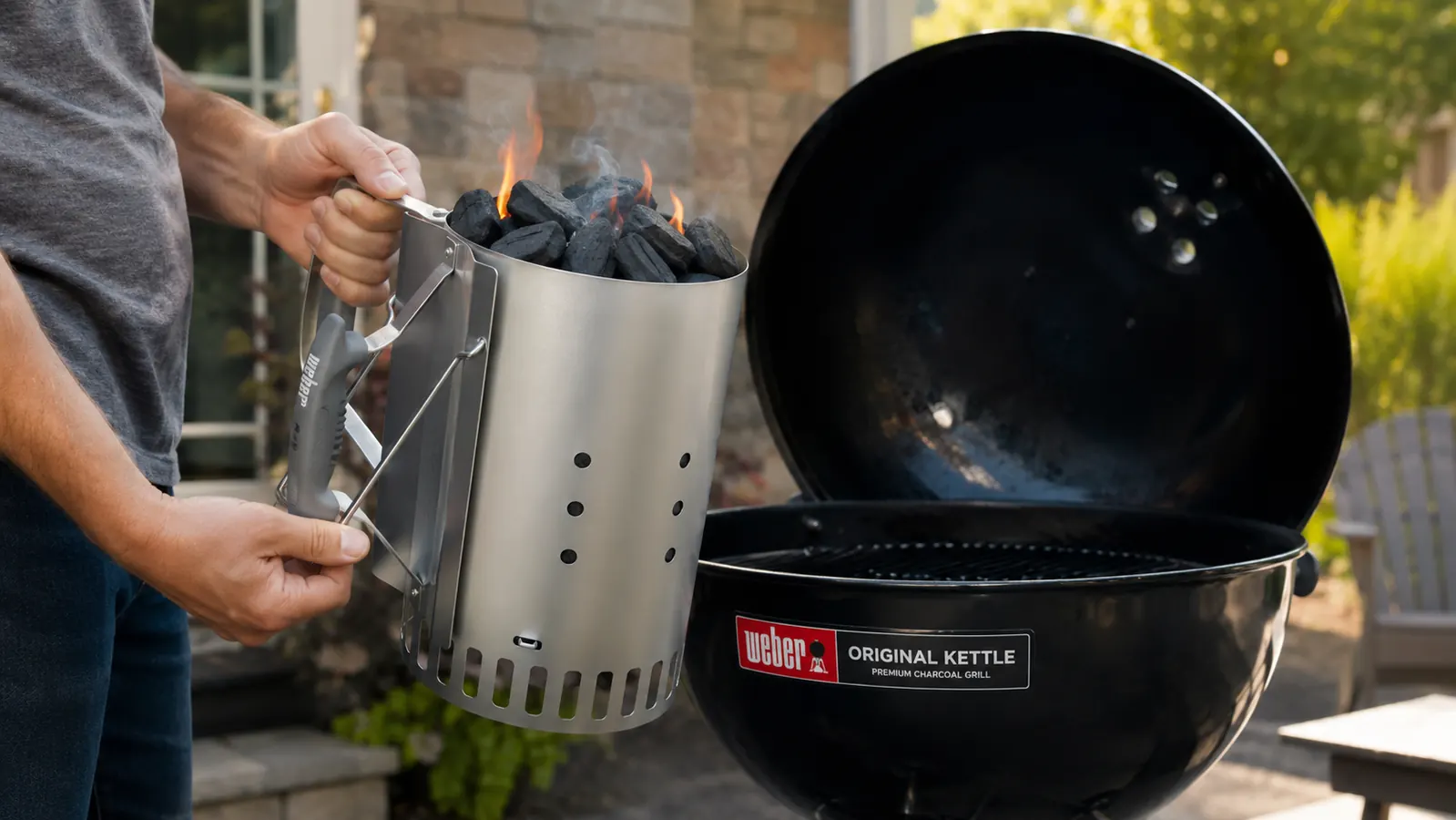
The Weber Original Kettle does not come with a chimney starter. That surprises a lot of buyers because the chimney starter is so fundamental to making charcoal grilling work well that it feels like it should be in the box. It is not. If your plan is to squirt lighter fluid on a pile of charcoal and let it rip, you will end up with coals that are unevenly lit, food that tastes faintly of petroleum, and a generally annoying experience.
A chimney starter costs around $15 to $20 and solves all of that. You fill it with charcoal, stuff a couple sheets of crumpled newspaper or a single paraffin cube underneath, light it, and in about 15 minutes you have uniformly lit coals with no chemical taste. Weber makes a chimney starter that fits perfectly with the kettle design. Factor it into your budget when you are pricing out this purchase. Think of it as the required accessory that the product page does not mention.
This is not a knock on the Weber. It is just information the listing does not surface. Every serious charcoal grill review should mention it and most do not.
Thing Two: The Learning Curve Is Real and Happens Fast
My third cook on this grill was a disaster. I had done burgers on the first cook and chicken thighs on the second, both went fine because those are forgiving high-heat cooks where you just want direct heat and a short cook time. On the third cook I tried indirect heat for bone-in chicken breasts. I did not understand how the vents worked yet, the coals ran hotter than I expected, and I ended up with chicken that was charred on the outside and still pink at the bone. I had to finish it in the oven and I was genuinely frustrated.
By the sixth cook I had figured it out. By the tenth cook, managing the vents felt intuitive. The learning curve on a charcoal kettle is real but it is also short, maybe five to eight cooks before you have a genuine feel for the fire. The frustration is temporary. The skill you develop is permanent and it makes every cook more satisfying once it clicks.
What I want you to understand is that if you buy this grill and the first few cooks do not go perfectly, that is not a grill problem. That is the nature of charcoal cooking and it resolves quickly with practice. Do not return this grill after cook three because of a chicken mishap.
The learning curve on a charcoal kettle is five to eight cooks, not two seasons. Once it clicks, managing the fire feels like second nature and the results justify every frustrating early session.
Thing Three: The Built-In Lid Thermometer Is Not Reliable
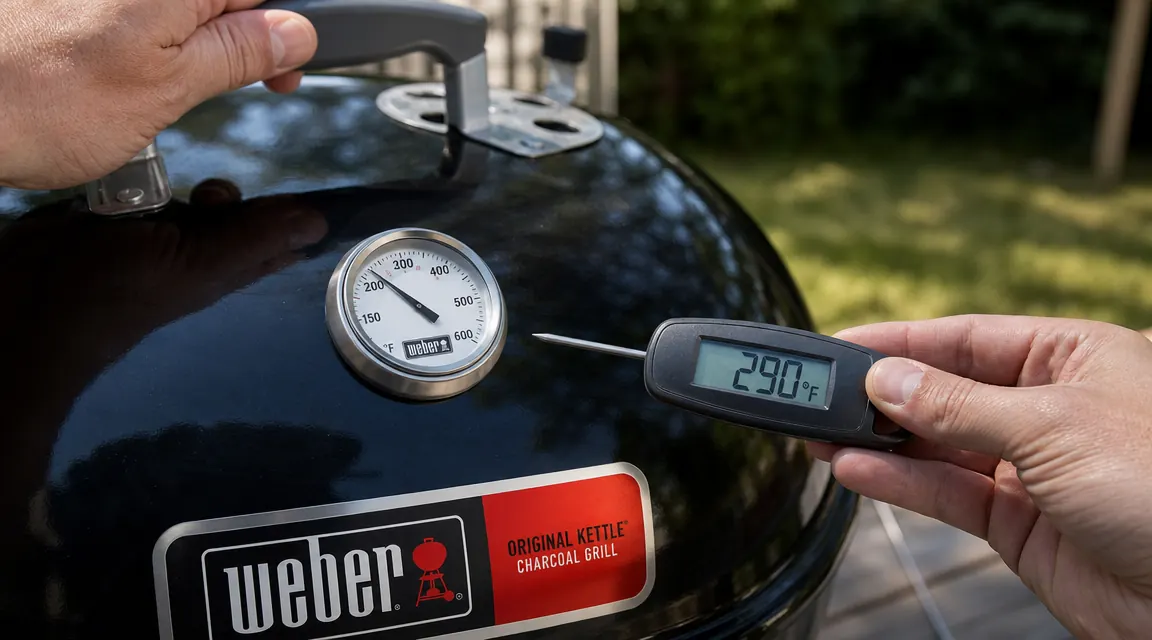
The Weber Original Kettle has a thermometer built into the lid. It is fine for a rough sense of temperature inside the grill, but if you are doing any kind of cook that requires temperature precision -- ribs at 275 degrees, chicken at a steady 350, anything where the difference of 30 degrees actually matters -- you should not trust it alone.
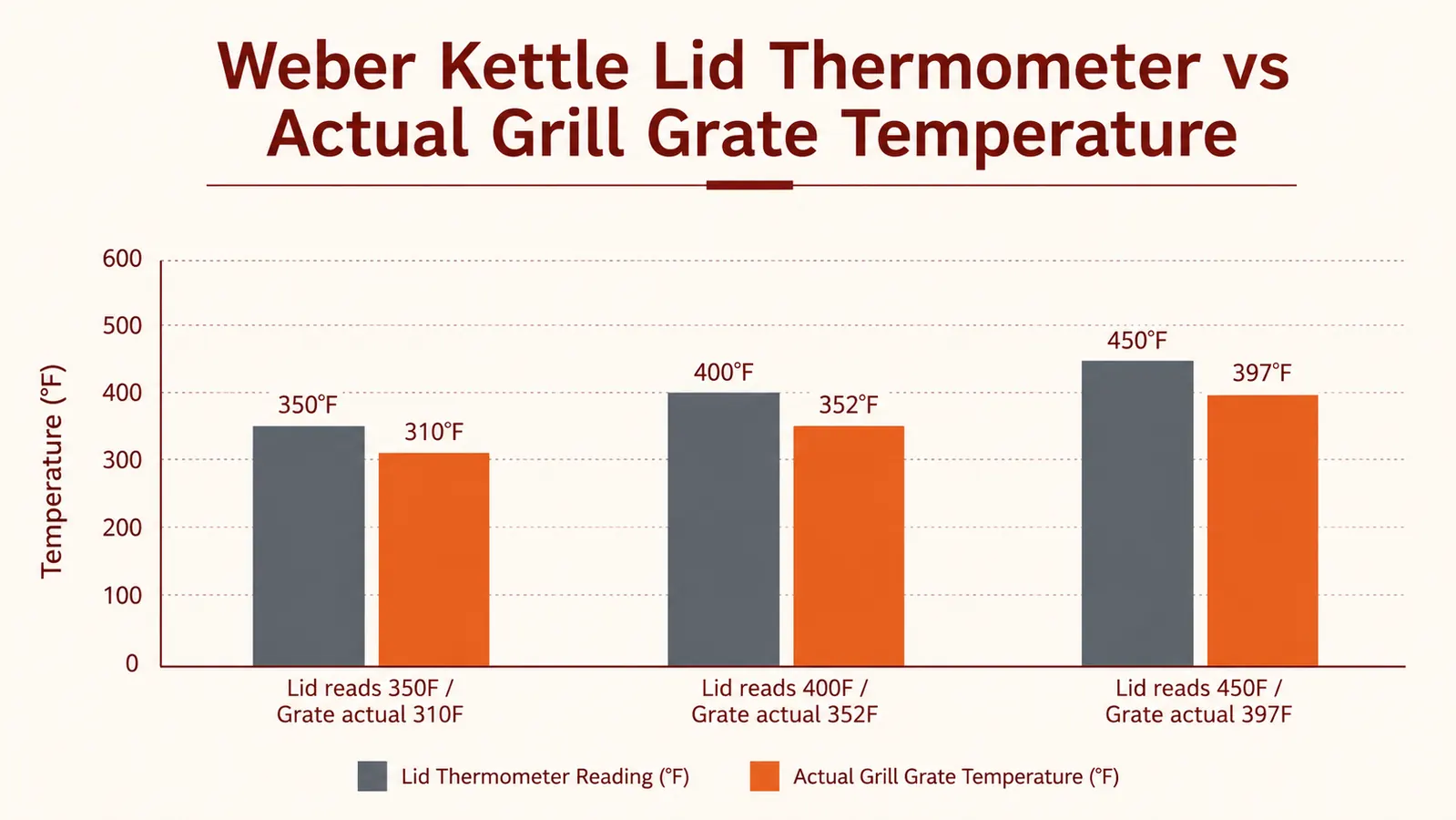
I tested the lid thermometer against a probe thermometer clipped at grate level on the same cook and found a difference of 40 to 50 degrees. The lid thermometer reads dome temperature, which is influenced by radiant heat from the lid. Grate temperature is what actually matters for the food. This is not unique to Weber -- it is a physics reality of dome thermometers on any kettle grill. But it means you should add a basic probe thermometer or a grate-clip thermometer to your toolkit. A good instant-read thermometer solves the meat temperature side of the equation, but for tracking ambient cook temperature accurately, you want a second data point.
This is the kind of thing an experienced charcoal cook knows without thinking about it, but it never appears on the product page or in the 4-and-5-star reviews from people who already know the workaround.
Thing Four: No Side Table Is a Real Inconvenience
The base Weber Original Kettle does not come with a side table or any shelf for tools, plates, or resting food. When you are actively cooking, you need somewhere to put a spatula, somewhere to rest a plate of raw chicken while you adjust the coals, somewhere to set a beer without putting it on the ground. On a gas grill, side tables are standard. On the base Weber kettle, they are not included.
In practice I use a folding table next to the grill, which works fine. Weber does sell a side table attachment for the kettle as an add-on accessory, and it clicks on well. But you will feel this absence on your first few cooks, especially if you are coming from a gas grill where you were used to having a surface right there. Plan for it before your first cookout rather than scrambling with a stack of plates on a patio chair.
Thing Five: Charcoal Has a Smell That Goes With You
This is the most obvious thing I have ever written and also the thing nobody seems to say out loud in a product review. When you cook on charcoal, you will smell like smoke afterward. Your hair, your shirt, your forearms. If you are cooking before a dinner party or before going somewhere after, budget time to change. This is not a flaw. It is the deal you make when you choose charcoal over gas. Charcoal produces real smoke and real smoke means you carry a bit of the cookout with you.
Some people love this. It feels like proof that a real cook happened. Some people find it annoying, especially in a backyard that is smaller and closer to the house where the smoke drifts toward windows and doors. If your outdoor setup is compact, position the grill with the lid vent pointing away from the house so smoke drafts away from where people are sitting. The Weber's vent position is adjustable and this trick works well.
Thing Six: The Cooking Grate Will Need an Upgrade Eventually
The standard cooking grate that comes with the Weber Original Kettle is chrome-plated steel. It is fine for everyday cooking and it is what millions of people use without issue for years. But if you cook on high heat frequently, chrome plating eventually shows wear and pitting. This is not a sudden failure -- it is gradual over a long time. The good news is that Weber sells replacement grates in stainless steel and cast iron that fit perfectly on the 22-inch kettle, and replacement parts are easy to find. Think of the original grate as the starter grate and plan for a stainless upgrade at some point if you cook heavily.
What I want to flag here is not the longevity concern -- the grate lasts a long time before it becomes an issue -- but the fact that the upgrade path is simple and affordable. You are not locked into the original configuration. Weber's parts ecosystem is one of the best reasons to buy into this platform rather than a cheaper kettle that uses proprietary or unavailable replacement components.
What I Liked
- Porcelain enamel bowl and lid hold up to real use for years without rust
- Vent system is precise enough for genuine temperature control once you learn it
- 22-inch cooking surface handles a family of four comfortably with room to work
- Weber replacement parts (grates, ash catchers, accessories) are widely available and affordable
- Build quality noticeably better than cheaper kettles -- feel the difference immediately
- 4.8 stars from 10,000-plus buyers reflects real long-term satisfaction, not just launch enthusiasm
- Works equally well for quick high-heat cooks and longer indirect cooks
- The upgrade path (grates, side tables, accessories) keeps this grill growing with your skills
Where It Falls Short
- No chimney starter included -- budget an extra $15 to $20 and buy one before your first cook
- Learning curve is real -- expect three to five cooks before fire management feels natural
- Lid thermometer reads 40 to 50 degrees higher than actual grate temperature -- get a secondary thermometer
- No side table in the base configuration -- you will need a folding table or the Weber add-on shelf
- Chrome-plated cooking grate shows wear on high-heat cooks over time -- plan for a stainless upgrade eventually
- Smoke on clothes and hair is part of the experience -- relevant if you are cooking before going somewhere
What Nobody Tells You About the Price
The Weber Original Kettle 22-inch runs at an affordable price at current pricing. That is the honest entry point. But your real first-year cost will be higher once you add a chimney starter, a bag of quality charcoal, a probe thermometer if you do not already own one, and a folding side table or the Weber shelf attachment if your patio does not have a surface nearby. Call it $200 to $230 all-in for a properly equipped setup. That is still excellent value compared to the alternatives in its class. I just want you to budget it accurately rather than being surprised.
The comparison that matters at this price point is not the Weber vs. a cheaper kettle -- it is the Weber vs. the lifetime cost of owning the cheaper kettle. The budget kettles at $60 to $80 at big-box stores typically show rust and deteriorating enamel in one to two seasons. A Weber at that affordable price that lasts eight to ten years with minimal maintenance is a significantly lower cost per year. That math is worth doing before you decide the Weber costs too much.
Who This Is For
The Weber Original Kettle is the right buy if you want a long-lasting charcoal grill that will reward you as your skills grow, and if you are willing to put in the five to eight cook learning curve to figure out fire management. It is ideal for families who cook outside on weekends, for people coming off a rusted big-box kettle who are ready for something built to last, and for anyone who has been curious about charcoal but has been put off by the perceived complexity. The complexity is real but it is brief. This grill makes a genuinely good cook out of most people who stick with it past those first few frustrating sessions.
Who Should Skip It
If you want to set a temperature and walk away for two hours without tending the fire, this is not your grill. A pellet grill does that better and you will be happier. If your household regularly feeds 10 or more people at once and batch cooking feels like a chore rather than a rhythm, look at a larger format or a second cooking surface. If the smell of smoke on clothes and hands genuinely bothers you or your household, a gas grill will serve you better day to day. None of these are reasons the Weber is a bad grill. They are reasons a different grill might be a better fit for your specific life.
You now know the full picture. If this grill fits your life, it will not disappoint you.
The Weber Original Kettle 22-inch is the standard that every other charcoal grill gets compared to, and it has held that position for good reason. Buy it knowing the real first-cook experience and you will come out of that learning curve with a grill you will use for years. Check current pricing on Amazon using the link below.
Amazon Check Today's Price on Amazon →